
24/7 — call any time • Serving 27 Wichita ZIP codes • Local Wichita water damage team
Water Damage Restoration in Wichita, KS
If water has entered your Wichita home, the clock matters more than the cleanup list. Stop the source if you can do it safely, stay clear of electricity near water, and call a professional today. Water left in carpet, padding and sheet rock should be dried within 24 to 48 hours; if it is not, assume mold growth (S9).
Call any time — if no one is available, leave a message and our team will call you back.
Who Should Call This Number, and Who Should Not
Use the number on this page if all three are true:
- The property is a home in one of the Wichita ZIP codes in the coverage section below.
- Water is in the house now, or got in within the last few days.
- The cause is a plumbing failure, an appliance or hot water tank leak, a roof or storm leak, a sump pump failure, a sewer backup, or flooding.
This is probably not the right place if there is no active water problem (mold-only questions are covered on the mold page), if the damage is from fire or smoke, or if the property is outside the ZIP list.
If you smell gas, see sparks, or the building feels unstable, leave and call 911 or your utility first.
Who We Are
ICT Water Pros is a Wichita water damage restoration company. Our team responds, inspects and does the work — we are not a guide or a referral service. When you call (316) 205-2900, our team answers the call, inspects your home, categorizes the water, provides an itemized scope, and does the restoration work.
We serve homes in 27 Wichita ZIP codes, 24 hours a day, 7 days a week. Learn more about us on the About page, or contact us with a question or a correction.
How Fast Water Damage Spreads, and When to Call
Water does not stay where it lands. It moves into carpet padding, travels up sheet rock by wicking, and drops into the space under the flooring where you cannot see it.
- First hours: surface water can be removed and the source stopped. This is the cheapest point to act.
- 24 to 48 hours: wet materials should be dried in that time; if they are not, assume mold growth (S9).
- After that: more material usually has to be cut out and replaced instead of dried.
You do not need to know the cause or the category before you call. A professional works that out on site. See the first 60 minutes checklist.
Mold After Water Damage: What Is Real and What Is Not
The real risk is hidden moisture. A wall can feel dry on the surface while the sheet rock paper and insulation behind it are still wet.
Two points cause most of the confusion:
- Testing is not remediation. A mold test tells you whether spores are present. It does not remove anything. Drying the structure is what holds mold off (S9).
- Surface sprays do not fix a moisture problem. If water is inside sheet rock or under flooring, wiping the surface leaves the cause in place.
About 10 square feet (about 3 ft x 3 ft) of visible mold is the point where professional help is the safer choice. See the mold after water damage page.
What Happens to Your Belongings After Water Damage
Photograph everything before you move it. Insurers ask for proof of condition, and you cannot take that photograph later.
- Usually cleanable: glass, metal, hard plastic, sealed wood.
- Often not recoverable if the water was Category 3: upholstery, mattresses, books, particleboard furniture, stuffed items.
- Pack-out: for larger jobs, a restoration company can move contents out so the structure can be dried and repaired.
Do not throw items away before they are photographed and listed.
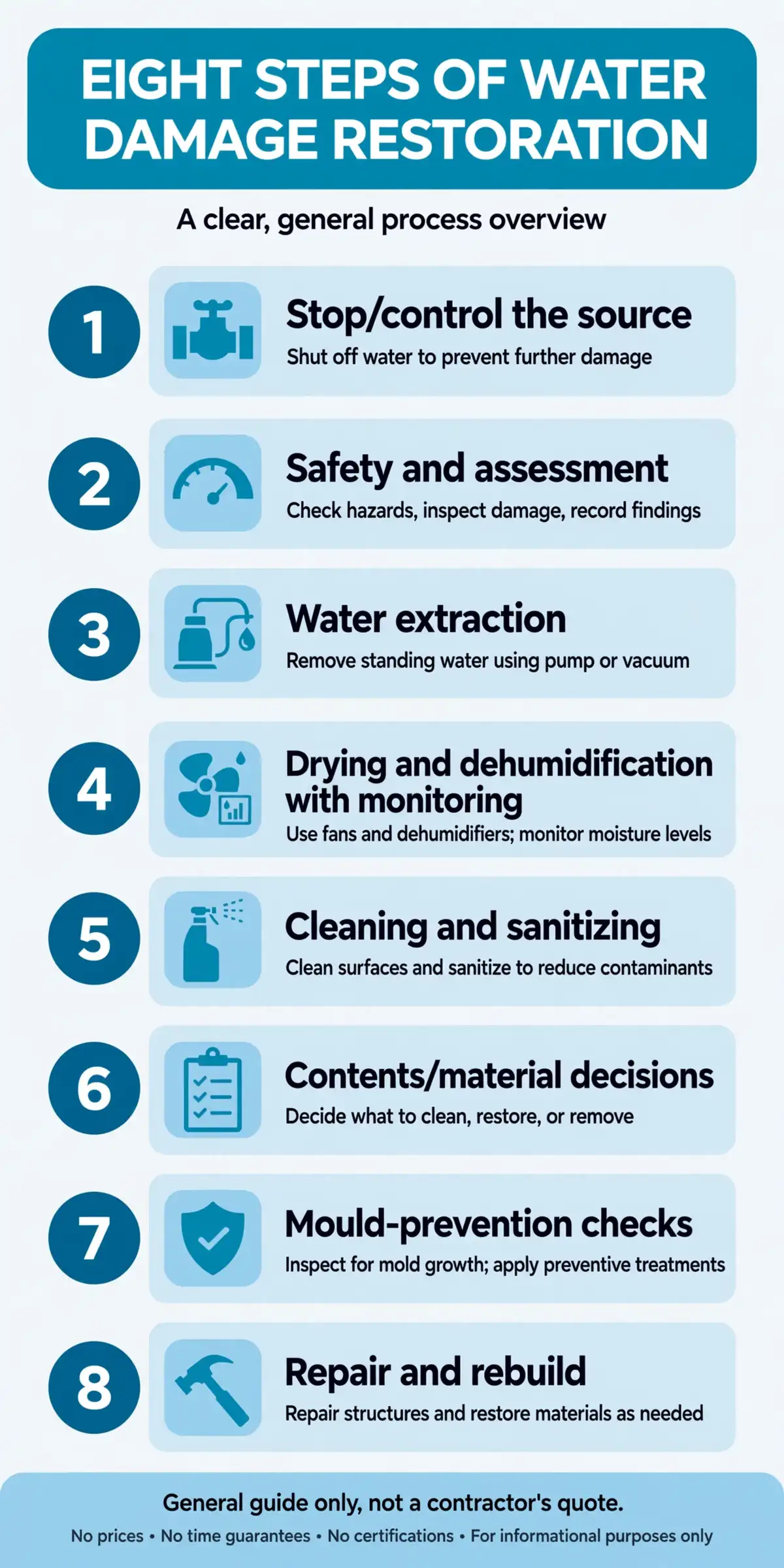
Water Damage Restoration Service in Wichita: What a Proper Job Includes
This is what a competent restoration company should do. Use it as a checklist when you compare estimates.
- Safety and source control. Stop the water, check for electrical and structural hazards, decide what is safe to enter.
- Inspection and categorization. Identify the water source, its category (1, 2 or 3) and its class, based on how much water and how deep it has soaked.
- Water extraction. Remove standing water with pumps and extractors before drying starts.
- Moisture mapping. A moisture meter confirms wet materials. An infrared camera can show temperature differences that point to hidden moisture. Readings are recorded.
- Structural drying. Air movers and dehumidifiers dry the structure. Equipment is placed on a plan, not guessed.
- Cleaning and antimicrobial treatment where the water category calls for it.
- Monitoring. Moisture readings are taken and written in a dry log until materials reach dry targets. Drying time depends on readings, not on a fixed number of days.
- Documentation and repair. Photos, readings and scope go to your insurer. Repairs follow once the structure is dry.
Mitigation vs Restoration: Two Different Jobs
- Mitigation stops the damage from spreading: extraction, drying, board-up, tarping, and moving contents out.
- Restoration repairs what was damaged: sheet rock, insulation, flooring, paint, cabinets. Many people call this rebuild.
Why it matters: the two phases are often scoped and billed separately. Ask every company which phase it is quoting.
Water Categories, What to Do, and National Cost Ranges
| Typical cause | Category (ANSI/IICRC S500) | What to do first | National cost per sq ft* |
|---|---|---|---|
| Broken supply line, fresh hot water tank leak, sink overflow | Category 1: clean source | Shut off water, extract, dry fast | about $3 to $4 |
| Washing machine or dishwasher overflow | Category 2: significantly contaminated | Extract, remove wet porous materials, clean and dry | about $4 to $7 |
| Sewage backup, rising river or flood water | Category 3: grossly contaminated | Stay out. Professionals only | about $7 to $7.50 |
*National figures cited by restoration vendors in 2026 (S8). Not Wichita prices.
Class describes how much water there is and how deep it has soaked in, from Class 1 (small area, little absorption) to Class 4 (deeply saturated materials). Category tells you how contaminated the water is. Class tells you how hard it is to dry. Both change the plan (S10). Note: the official text for this standard has not been obtained; the statements here rest on the secondary sources listed.
What Water Damage Restoration Costs in Wichita
We have not found published Wichita-specific restoration prices, so we do not quote one. What we can source: national figures from two public sources, vendor and media estimates, put the average restoration job at about $3,455 (Bob Vila, updated May 2023) and $3,867 (PushLeads, 2026) (S8). Per square foot, those sources cite about $3 to $4 for Category 1, about $4 to $7 for Category 2, and about $7 to $7.50 for Category 3 (S8). Your price moves with the category, the class, the square footage, how many days of equipment are needed and whether repairs are included. Ask for an itemized estimate that lists extraction, equipment days, antimicrobial treatment, monitoring and repairs. See water damage cost in Wichita.
What Can Be Saved and What Has to Go
| Material | Clean water (Category 1), caught early | Category 2 or 3, or water that sat |
|---|---|---|
| Carpet | Often dried in place | Carpet and pad usually removed |
| Carpet pad | Often replaced | Removed |
| Sheet rock | Can sometimes be dried if only the lower portion is wet | Wet or contaminated sections cut out and replaced |
| Insulation | Wet batt insulation is commonly replaced | Removed |
| Hardwood and subfloor | May dry with specialty drying | Often removed if contaminated or cupped |
| Hard, non-porous items | Cleaned | Cleaned and disinfected |
This is general guidance. The decision depends on a moisture reading, not on appearance.
What Good Follow-Up Looks Like
A restoration job is not finished when the equipment arrives. Look for:
- Daily moisture readings recorded in a dry log, and a copy for you and your insurer.
- Equipment moved or removed based on readings, not on a fixed number of days.
- Final readings in writing before any wall is closed up or flooring goes back.
- A clear written line between the mitigation work and the repair work.
If a company cannot show readings, you are being asked to trust a surface that may still be wet.
Common Causes of Water Damage in Wichita
- Frozen and burst pipes. Winter freezes crack supply lines, and the water runs until someone shuts it off. A hot water tank leak can do the same damage indoors. See burst pipe water damage.
- Hail and storm roof leaks. Water enters through damaged roofing into ceilings and attics, and the first sign is often a stained ceiling. See storm and hail water damage.
- Basement seepage and sump pump failure. Water pressure in saturated soil can push water through foundation cracks and window wells. A sump pump failure leaves that water with nowhere to go. See flooded basement cleanup.
- Sewer and drain backup. Water coming up through a floor drain is Category 3. Do not handle it yourself.
- Flash flooding and river flooding. Rising river or flood water is Category 3. Creeks and rivers named in the June 2026 NWS report include the Arkansas River and its tributaries. See flood cleanup.
- Appliance failures. Washing machine supply lines, dishwashers and ice maker lines cause many slow, hidden losses.
- Standing water that needs removing fast. For extraction first, see emergency water extraction.
Wichita Facts That Change How You Respond
- 25 to 26 June 2026: the National Weather Service recorded a daily rainfall record of 5.31 inches in Wichita (S1).
- 3 June 2025: flash flooding hit east Wichita, including the Kellogg and Hillside ramp, Bleckley and Edgemoor (S2).
- Floodway: the Wichita and Valley Center Local Protection Project was authorized in 1936, built in the 1950s, and moves river water around the city (S6).
For the full picture see Wichita flood-prone areas and the Wichita water damage fact sheet.
Three Wichita Water Events and What They Teach
These are documented public events, not a list of our completed jobs.
Case File 1: The June 2026 Flash Flood
What happened. On 25 to 26 June 2026 Wichita recorded 5.31 inches of rain in a day, a record for that date (S1). What it teaches. Flood water is Category 3. It is not a do-it-yourself job, and it is usually not covered by a homeowners insurance policy; flood coverage is generally a separate policy.
Case File 2: The June 2025 East Wichita Flash Flood
What happened. On 3 June 2025 flash flooding hit east Wichita, including the Kellogg and Hillside ramp, Bleckley and Edgemoor (S2). What it teaches. Urban runoff can fill a basement fast, away from any river. The response window is short, so photograph damage early and call promptly.
Case File 3: The “Protected City” Assumption
What happened. The Wichita and Valley Center Local Protection Project was authorized in 1936, built in the 1950s, and is designed to move river water around the city (S6). What it teaches. The floodway is built to move river water around the city. It does not control rain runoff in streets or seepage into basements.
Areas We Serve
We serve homes in these 27 Wichita ZIP codes:
| 67202 | 67203 | 67204 |
| 67205 | 67206 | 67207 |
| 67208 | 67209 | 67210 |
| 67211 | 67212 | 67213 |
| 67214 | 67215 | 67216 |
| 67217 | 67218 | 67219 |
| 67220 | 67223 | 67226 |
| 67227 | 67228 | 67230 |
| 67232 | 67235 | 67260 |
Coverage outside these ZIP codes is not confirmed. Surrounding towns may not be included.
How This Page Was Made
Statistics on this page are tied to the sources listed at the bottom. The page shows a last reviewed date and a method page: Sources and Methodology.
We do not publish unverified customer reviews, job counts or crew claims.
Editor: the ICT Water Pros editors. Corrections: call (316) 205-2900 or use the Contact page.
Sources
- S1: National Weather Service Wichita, 25 to 26 June 2026 event page. https://www.weather.gov/ict/event_20260625
- S2: National Weather Service Wichita, 3 June 2025 event page. https://www.weather.gov/index.php/ict/event_20250603
- S3: U.S. Census Bureau QuickFacts, Wichita city, Kansas. https://census.gov/quickfacts/fact/table/wichitacitykansas/PST045223 Not opened, no figure used.
- S5: USGS, historic floods along the Arkansas River. https://www.usgs.gov/centers/central-plains-water-science-center/historic-floods-along-arkansas-rive
- S6: Sedgwick County, water and stormwater factsheet. https://www.sedgwickcounty.org/media/29164/water-and-stormwater-factsheet.pdf
- S7: Kansas Insurance Department, storm and flood consumer page. https://www.insurance.kansas.gov/consumers/storm-and-flood
- S8: National restoration cost benchmarks, 2026 (vendor and media estimates). https://www.bobvila.com/articles/water-damage-restoration-cost/ and https://pushleads.com/restoration-company-seo/water-damage-restoration-cost/
- S9: CDC and EPA mold guidance (timing and cleanup thresholds). https://www.epa.gov/mold/brief-guide-mold-moisture-and-your-home and https://www.cdc.gov/mold-health/media/Homeowners_and_Renters_Guide.pdf
- S10: ANSI/IICRC S500 (categories, classes, drying). https://iicrc.org/s500/ Note: the official text for this standard has not been obtained; the statements here rest on the secondary sources listed.
- S11: Audacy/KNSS, Flash Flood Emergency for Wichita. https://audacy.com/knss/news/local/flash-flood-emergency-wichita
Note: there is no S4 in this list. Last reviewed: 2026-10-25
How We Serve You
Call (316) 205-2900 and tell our team your name, ZIP code and problem type. Calling is free; you only pay if you hire us for the work.
- Our team answers your call. We take your name, phone, ZIP code and problem type, and confirm whether the property is in our service area.
- We inspect your home. We check the source, the affected materials and any safety hazards.
- We categorize the water. We identify the water category (1, 2 or 3) and class, and map moisture with a meter.
- We provide an itemized scope. You receive a written scope that separates mitigation from repairs, with equipment, monitoring and treatment listed.
- We do the work. We extract water, dry the structure, monitor readings in a dry log, and complete repairs once the structure is dry.
- We document the job for your insurer. Photos, readings and the scope are recorded, and final readings are provided in writing before walls are closed up.
If you call after hours, leave a message and our team will call you back. We do not promise instant dispatch.
DIY or Professional: A Direct Comparison
DIY can work when:
- The water is clean (Category 1) and the area is small.
- You find it fast and can remove it and dry it within a day.
- It is on a hard, non-porous surface.
Call a professional when:
- The water is Category 2 or 3: sewage, flood water, groundwater, or an appliance overflow.
- Water got into walls, under flooring, or into insulation.
- It has sat longer than 24 to 48 hours.
- The area is too large to dry quickly with household fans.
- You see mold covering about 10 square feet (about 3 ft x 3 ft) or more (S9).
The cost of a wrong DIY call is hidden moisture, which is how a drying job becomes a mold job.
How to Choose a Water Damage Company in Wichita
- Ask for proof of liability insurance.
- Ask for the IICRC Certified Firm number and verify it on the IICRC site yourself.
- Ask for an itemized, written scope that separates mitigation from repairs.
- Ask how moisture will be measured and whether you get a copy of the dry log.
- Ask who will be on site and how they are supervised.
- Be careful with vague promises about response times, and with pressure to sign before you have talked to your insurer.
Water Damage and Insurance in Kansas
Insurance is the first question most people ask, and the answer depends on the cause of the water, not on the amount of damage.
- Sudden and accidental (a burst pipe, a failed supply line) is generally the kind of loss standard homeowners policies cover.
- Gradual leaks and lack of maintenance are commonly excluded.
- Flood is generally not covered by a homeowners policy. Flood coverage is a separate policy, often through the National Flood Insurance Program.
- Sewer or drain backup and sump pump failure usually need an added endorsement. Check whether you have one before you need it.
- Wind and hail: ask whether your policy has a separate deductible for storm damage.
Document first, then call your insurer early. Ask whether you must use a preferred vendor. Full guide: water damage insurance in Kansas. Official consumer information: Kansas Insurance Department, storm and flood page (S7).
What to Read Next
- Emergency Water Extraction in Wichita, KS
- Flooded Basement Cleanup in Wichita, KS
- Burst Pipe Water Damage in Wichita, KS
- Storm and Hail Water Damage in Wichita, KS
- Flood Cleanup in Wichita, KS
- Water Damage Cost in Wichita
- Water Damage Insurance Guide for Kansas
- First 60 Minutes After Water Damage
- Mold After Water Damage
- Wichita Flood-Prone Areas
- Wichita Water Damage Facts
- Sources and Methodology
- About ICT Water Pros
- Contact ICT Water Pros
Call (316) 205-2900 any time for water damage help in Wichita.
Frequently Asked Questions
Quick answers to common water damage questions.
How Fast Should Water Be Removed After a Leak or Flood in Wichita?
As soon as it is safe, ideally within the first 24 hours. Standing water soaks into carpet, padding and sheet rock, and wet materials should be dried within 24 to 48 hours.
How Long Does It Take for Mold to Grow After Water Damage?
Wet materials should be dried within 24 to 48 hours; if they are not dried in that time, assume mold growth (S9).
Can Wet Carpet, Padding and Sheet Rock Be Saved?
Sometimes. Carpet exposed to clean water (Category 1) can often be dried if the water is removed quickly. Carpet pad is often replaced. Sheet rock can sometimes be dried if only the lower portion is wet; wet or contaminated sections are cut out and replaced.
Does Homeowners Insurance Cover Water Damage in Kansas?
It depends on the cause. Standard homeowners policies generally cover sudden, accidental water damage, such as a burst pipe. Gradual leaks are commonly excluded, and flood is generally a separate policy. See water damage insurance in Kansas (S7).
How Much Does Water Damage Restoration Cost in Wichita?
No Wichita-specific prices have been published that we could find. National figures put the average job at about $3,455 (Bob Vila, updated May 2023) and $3,867 (PushLeads, 2026) (S8) — about $3 to $4 per square foot for Category 1, $4 to $7 for Category 2, and $7 to $7.50 for Category 3. See water damage cost in Wichita.
What Are the Steps of Water Damage Restoration?
Safety and source control, inspection and water categorization, water extraction, moisture mapping, structural drying, cleaning and antimicrobial treatment where needed, monitoring in a dry log, and documentation and repair.
What Is the Difference Between Water Mitigation and Water Damage Restoration?
Mitigation stops the damage from spreading: extraction, drying, board-up, and moving belongings out. Restoration repairs what was damaged: sheet rock, insulation, flooring, paint and cabinets. The two phases are often scoped and billed separately.
What Do Category 1, 2 and 3 Water Mean?
Under the ANSI/IICRC S500 standard (S10), Category 1 is water from a clean source, such as a broken supply line. Category 2 is significantly contaminated water, such as a washing machine overflow. Category 3 is grossly contaminated water, such as sewage backup or rising river water.
Should I Clean Up Water Damage Myself or Call a Professional?
You can handle a small, clean-water spill that you can dry within a day. Call our team for sewage, flood water, water in walls or under flooring, water that has sat longer than 24 to 48 hours, or mold over about 10 square feet. Call (316) 205-2900.
How Long Does It Take to Dry a Water-Damaged Home?
It depends on the materials and the moisture readings. Our team records readings in a dry log and removes equipment based on readings, not on a fixed number of days.
What Should I Do in the First Hour After Water Damage?
Stop the water at its source if it is safe, and turn off power to wet areas only if you can do so without standing in water. Photograph the damage before moving items, then call (316) 205-2900. See the first 60 minutes checklist.
Does the Big Ditch Protect Wichita Homes From Flooding?
The Wichita-Valley Center Floodway, built in the 1950s (S6), is part of a flood protection project that moves river water around the city. It does not prevent street flooding from heavy rain or seepage into basements.
How Do I Choose a Water Damage Restoration Company in Wichita?
Ask for an itemized written scope that separates mitigation from repairs, how moisture will be measured, whether you get a copy of the dry log, and proof of liability insurance. Ask us the same questions — see how to choose a water damage company.
Which Wichita ZIP Codes Does This Service Cover?
We serve homes in the 27 Wichita ZIP codes listed in the Areas We Serve section. Coverage outside these ZIP codes is not confirmed.
Is This Site a Restoration Company?
Yes. ICT Water Pros is a Wichita water damage restoration company. Our team responds, inspects and does the work. Call (316) 205-2900 any time.